
LPS has procured Axon Body 4 cameras to record audio and video during public interactions. The battery life of these cameras is expected to last an entire 12-hour shift.
Body Worn Cameras
Police officers are entrusted with extraordinary powers and often work in dynamic and high-conflict situations.
Body Worn Cameras (BWC) are tools utilized by law enforcement across the province to provide an unbiased, independent account of interactions between police and the community, protecting both and supporting a fair justice system by:
- Enhancing transparency, public trust and confidence
- Enhancing officer accountability and professionalism by providing real-life training examples
- De-escalating situations and reducing use-of-force incidents by and against the police
- Protecting officers from unfounded allegations of misconduct
- Increasing the efficiency of the resolution of complaints against the police
- Improving evidence collection, documentation and prosecution; aiding in early case resolution
The Lethbridge Police Service (LPS) is committed to deploying BWCs openly and responsibly, in accordance with the Canadian Charter of Rights and Freedoms, applicable privacy legislation and the Alberta Provincial Policing Standards.
Operations and Use
While BWCs are always actively buffering, officers must manually initiate recording by tapping the button at the centre of the BWC device.
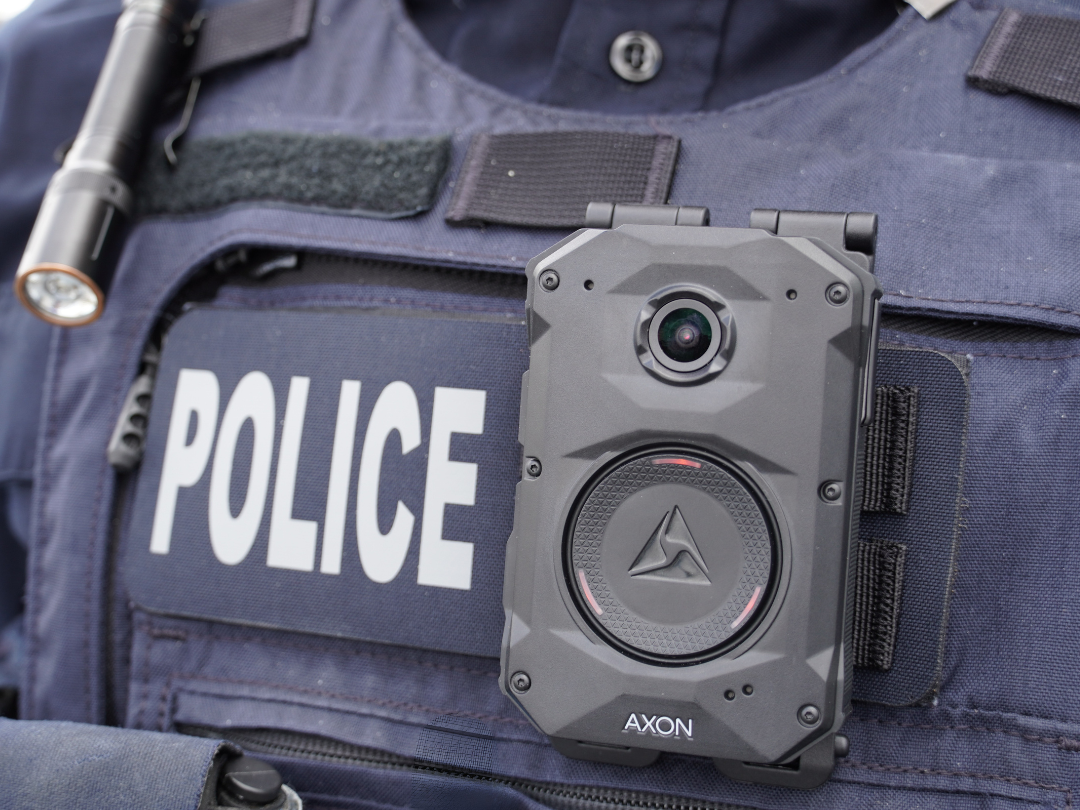
When the camera starts recording, it will:
- Capture 30 seconds of visual data from the moments immediately prior to the start of the recording
- Emit an audible beep, indicating that recording has begun
- Activate a flashing red light below the lens that remains on during recording (NOTE: This light can be turned off for safety reasons, such as during nighttime incidents involving firearms)
When will body-worn cameras be used?
Officers are expected to activate their BWC at the earliest, safest opportunity whenever a lawful policing interaction is anticipated or underway, including but not limited to:
- Responding to a call for service
- Making an arrest
- Conducting a traffic stop
- Executing a warrant
- Engaging in interactions that may become confrontational
- Any situation that may need to be recorded for evidence
Officers must continually assess and reassess whether recording is lawful, necessary and achieves an appropriate balance between safety and privacy.
When won't body-worn cameras be used?
BWCs are not intended to be used covertly and officers will deactivate them when a call for service or investigation is complete or when the officer determines that continuous recording is no longer serving its intended purpose.
The LPS body worn camera policy also identifies places and situations where it would not be appropriate to record, except in emergency or exigent circumstances. For example, during intimate searches or in circumstances where legal privilege exists.
BWCs are not required in the LPS short-term holding facility or the front desk, where CCTV systems are already in place.
Who will be wearing body-worn cameras?
All uniformed Police and Community Peace Officers will be equipped with BWCs.
Plain clothes officers will also have access to BWCs in the course of their duties, as required.
What happens if an officer does not turn their camera on or follow procedures?
LPS recognizes that the proper use of BWCs is essential to enhancing public trust and legitimacy. Conversely, improper use can have a detrimental impact on police–community relations.
Officers are required to activate their BWC when an interaction becomes investigative or enforcement-related.
In limited circumstances, officers may need to deactivate their BWC. When this happens, the officer must document their reasons for doing so. Examples include protecting a vulnerable person or child, avoiding the capture of personal information in sensitive locations such as medical or legal offices, or when operational tactics are being discussed.
If an officer fails to activate their camera in a lawfully required circumstance, or does not follow established procedures, complaints may be directed to either the Lethbridge Police Service or the Alberta Police Review Commission to initiate an investigation. Based on the findings of that investigation, officers may be subject to a range of disciplinary actions.
How much does the body-worn camera program cost?
The estimated annual cost to operate the BWC program is $950,000. This includes the cost of the cameras, digital evidence management software and four civilian positions to manage the program.
Data Storage and Management
Officers complete their notes before reviewing BWC footage. BWC recordings are intended to support observations and supplement reports.
At the end of every shift, officers dock their cameras. The footage is automatically uploaded to the Axon's secure, centralized Digital Evidence Management System software.
To support the addition of BWCs in police operations, LPS has established a Body Worn Camera Unit consisting of four civilian positions: one Coordinator and three Media Disclosure Technicians. The unit will manage video evidence, including visual and audio redactions, disclosures and compliance with privacy legislation.
All recorded BWC data is uploaded to Axon's secure, centralized Digital Evidence Management System, which is housed on a Canadian-based cloud system. The DEMS complies with technological specifications set out by the provincial government within the Alberta Provincial Policing Standards.
Axon Inc. is a worldwide leader in this technology and done extensive work to demonstrate that their system is secure.
How long will body-worn camera data be stored?
Body-worn camera recordings will be retained for a minimum of 13 months, unless there is a legitimate reason to keep them longer, such as for court proceedings or ongoing investigations.
If a recording becomes part of a case file, it will be retained in accordance with the LPS records retention schedule, which governs how long information is stored based on the type of case and its assigned retention category.
Privacy and Disclosure
The collection, use and disclosure of BWC footage is governed by both the Protection of Privacy Act and the Access to Information Act.
BWC recordings are retained and disclosed as evidence to the Crown as part of the prosecution process.
In limited circumstances, LPS may publicly release camera footage to further an investigation.
Public requests for video footage from BWCs follow the same process as other record requests.
Are officers required to inform that they are recording?
When safe and practicable, officers will advise that they are recording. However, notification is not always possible and officers must always consider operational and safety considerations.
Can an officer be asked to stop recording?
In alignment with LPS policy, officers are required to have their body-worn camera activated during law enforcement interactions with the public.
They are also trained to constantly assess and balance privacy rights with enforcement needs to determine if recording should continue or stop.
Can I view or obtain a copy of body-worn camera video footage of an incident that I was involved in?
To view or request access to a BWC recording for an incident that you are directly involved in, you can file a Routine Request for Information.
Please note that the fee for the production of multimedia will need to be received before the file is provided. and that all third-party information will be removed or blurred from the video.